Plateforme e-learning IDEP
Institut africain de développement économique et de planification


Promouvoir l'apprentissage
Apportez le tutorat directement à votre domicile.
Prenez les meilleurs cours du monde, en ligne.
Apprendre et s'amuser pour tout le monde.
Institut africain de développement économique et de planification
Depuis sa création, l’IDEP aide les gouvernements africains dans leurs efforts de formation et de renforcement des capacités dans les domaines de la gestion et de la planification économiques. À cet égard, il travaille en étroite collaboration avec les États membres africains pour évaluer leurs besoins et développer des cours généraux, spécialisés et adaptés à leurs cadres de niveaux moyen et supérieur.


Les noms dont nous sommes fiers

Mouhamed TIMOULALI, PHD
Docteur, Ingénieur

Mme Biandri Joubert
Chercheur LLD

Abbi Mamo Kedir, PHD
Professeur Agrégé

Dr Fodiyé Bakary DOUCOURE
Professeur assistant

Tadele Ferede, PHD
Ph.D., Maître Assistant

M. Thierry Amoussougbo
Head of KM and E-Learning

Amadou Mbaye DIOP
Docteur en Economie

Antoine BOUËT,
Professeur en Economie

Vinay Ancharaz
Consultant et Formateur
La formation intitulée « Lutte contre les flux financiers illicites : comprendre les impacts socio-économiques, les méthodes de mesure et les interventions politiques » vise à renforcer les connaissances, les compétences et les capacités des participants afin qu’ils puissent analyser et lutter contre les flux financiers illicites en Afrique et au-delà.
Comprendre l’écosystème des flux financiers illicites
Définir les flux financiers illicites, les distinguer des flux financiers connexes et expliquer leurs impacts économiques, sociaux et politiques.
Identifier les principaux facteurs, mécanismes et tendances mondiales et africaines en matière de flux financiers illicites.
Appliquer des méthodologies de mesure
Utiliser les cadres de référence de la CNUCED pour mesurer les flux financiers illicites liés à la fiscalité et au commerce (par exemple, la fausse facturation commerciale, le transfert de bénéfices, la fortune offshore).
Appliquer les méthodologies de l’ONUDC pour mesurer les flux financiers illicites provenant de la criminalité et des marchés illégaux (par exemple, le trafic, la corruption, le financement du terrorisme).
Évaluer les atouts, les limites et les besoins en données des différentes approches de mesure.
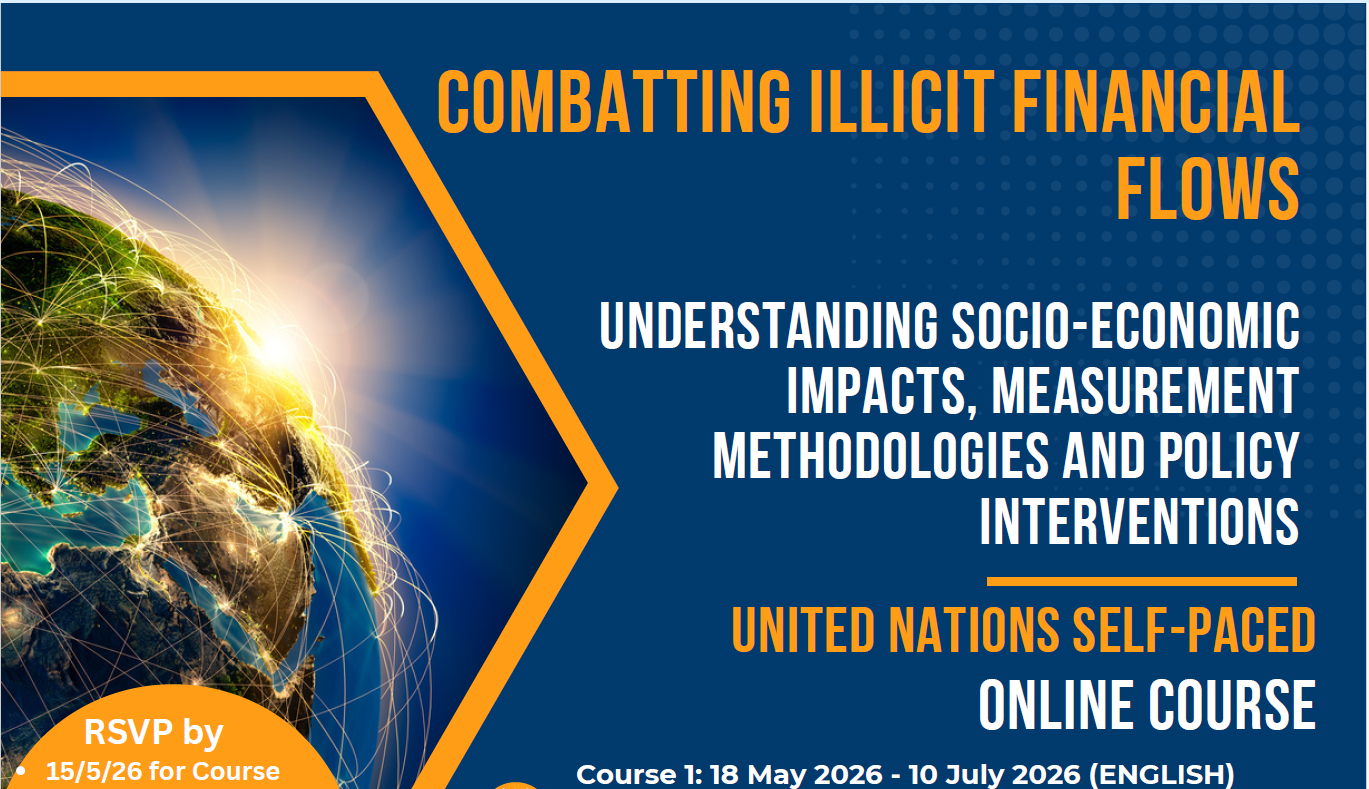
The course Combatting Illicit Financial Flows: Understanding Socio-economic Impacts, Measurement Methodologies and Policy Interventions aims to build the knowledge, skills, and capacity of participants to analyse and address IFFs in Africa and beyond.
Understand the Ecosystem of IFFs
Define IFFs, distinguish them from related financial flows, and explain their economic, social, and political impacts.
Recognise the main drivers, mechanisms, and global/African trends in IFFs.
Apply Measurement Methodologies
Use UNCTAD’s frameworks to measure tax- and trade-related IFFs (e.g. trade misinvoicing, profit shifting, offshore wealth).
Apply UNODC methodologies to measure IFFs from crime and illegal markets (e.g. trafficking, corruption, terrorism financing).
Assess the strengths, limitations, and data requirements of different measurement approaches.
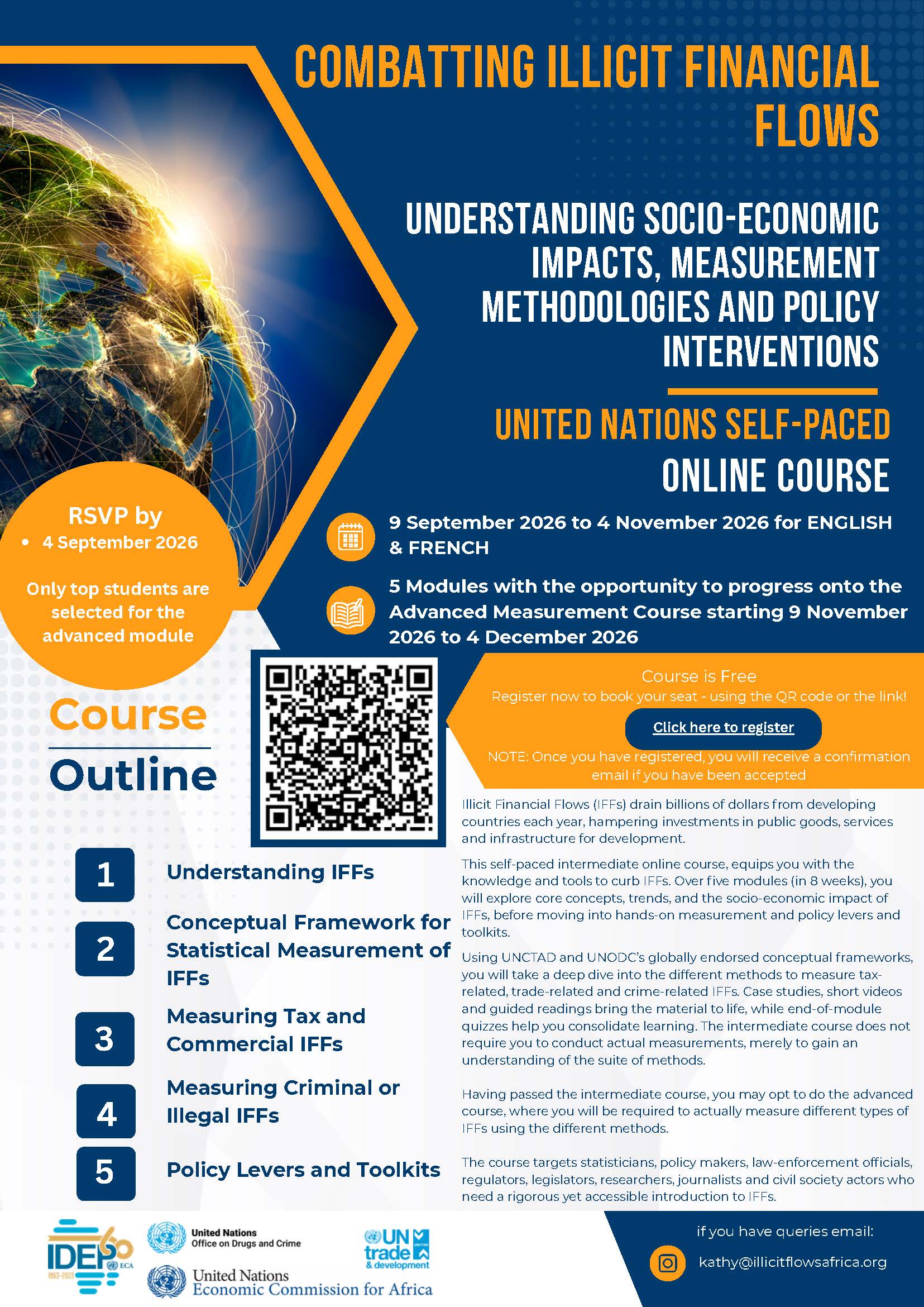
Illicit Financial Flows (IFFs) drain billions of dollars from developing countries each year, hampering investments in public goods, services and infrastructure for development.
This self-paced intermediate online course, equips you with the knowledge and tools to curb IFFs. Over five modules (in 8 weeks), you will explore core concepts, trends, and the socio-economic impact of IFFs, before moving into hands-on measurement and policy levers and toolkits.
Using UNCTAD and UNODC’s globally endorsed conceptual frameworks, you will take a deep dive into the different methods to measure taxrelated, trade-related and crime-related IFFs. Case studies, short videos and guided readings bring the material to life, while end-of-module quizzes help you consolidate learning. The intermediate course does not require you to conduct actual measurements, merely to gain an understanding of the suite of methods.
Having passed the intermediate course, you may opt to do the advanced course, where you will be required to actually measure different types of IFFs using the different methods.
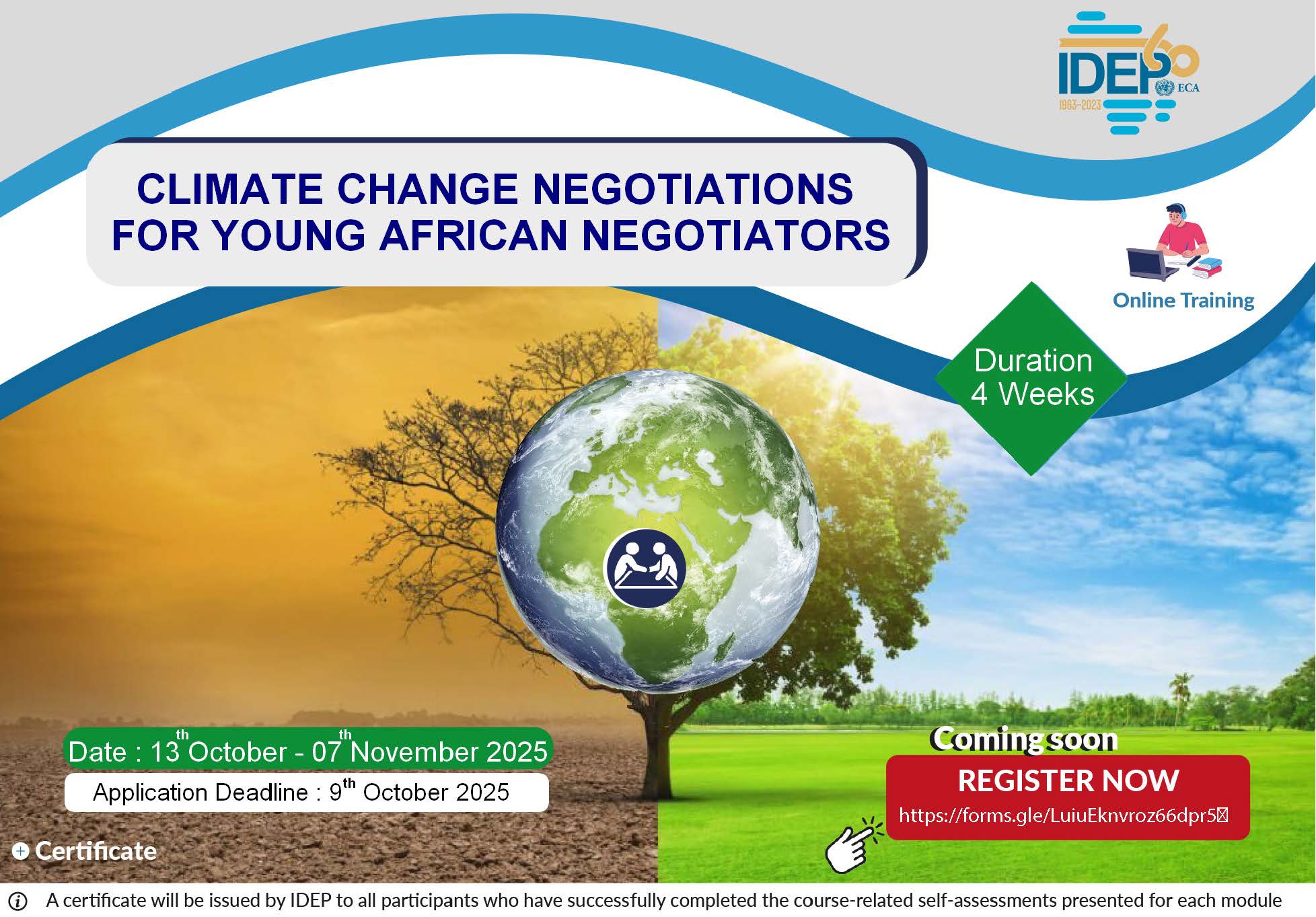
The multilateral climate change processes have evolved over time from the non-binding commitment under UN Convention to the legally binding commitments for developed countries under the Kyoto Protocol and to the Paris Agreement (PA) that build upon the convention and brings all nations into a common cause to undertake ambitious efforts to combat climate change and adapt to its effects, with enhanced support to assist developing countries. The PA also address the issues of loss and damage.
Following the completion of the PA’s rulebook, the process is now focusing on the implementation of mitigation and adaptation with enhanced support to assist developing countries to achieve their commitments. The PA added the loss and damage into its workstream. This online training will deal with negotiation of work programmes under the following areas; just transition; adaptation mainly dealing with adaptation finance and capacity; operationalization of the loss and damage fund and its assessment; negotiating carbon markets; climate finance in the context of financing adaptation, assess to existing funds, methods of tracking, project development, monitoring and evaluation, gender and youth.

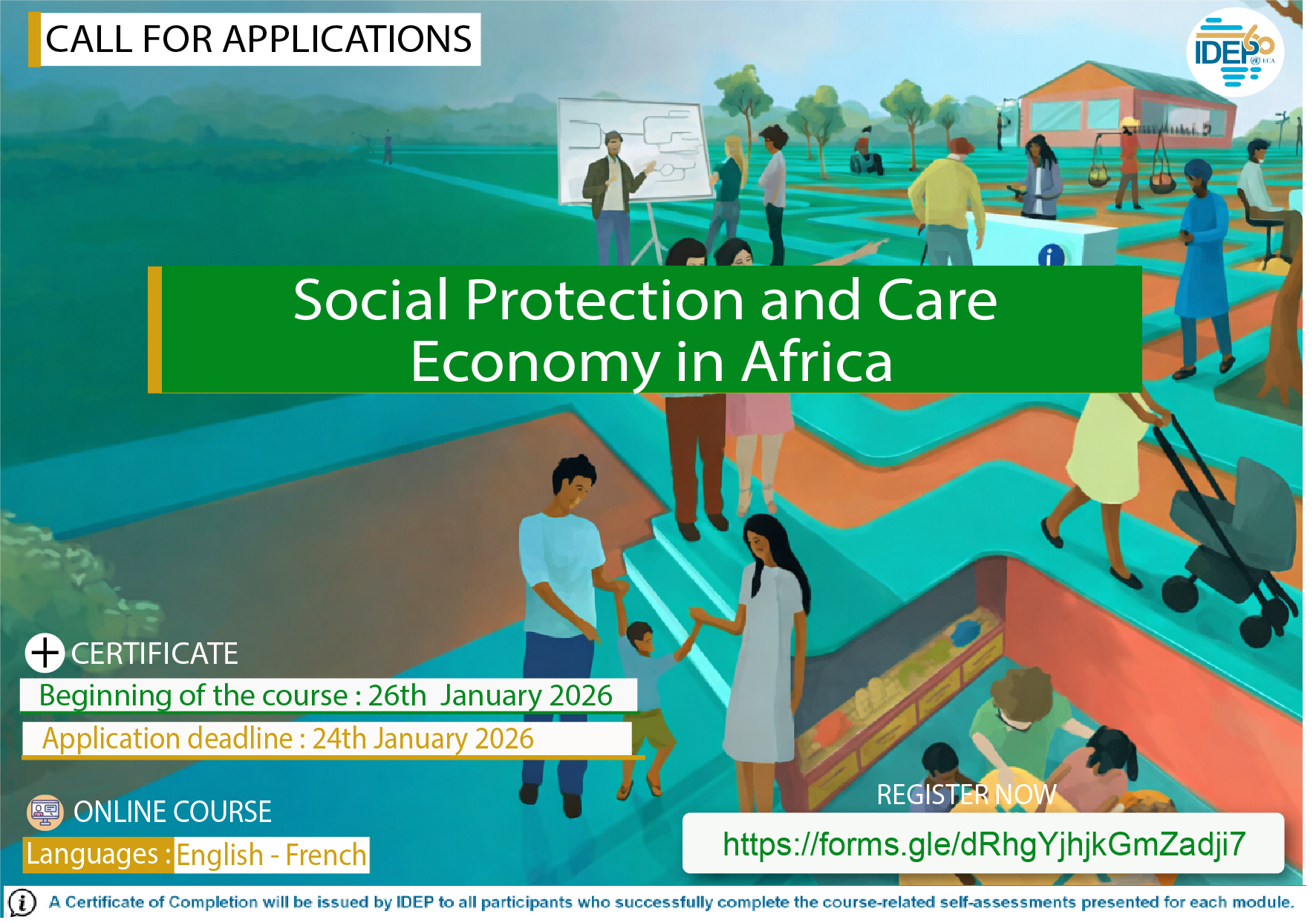
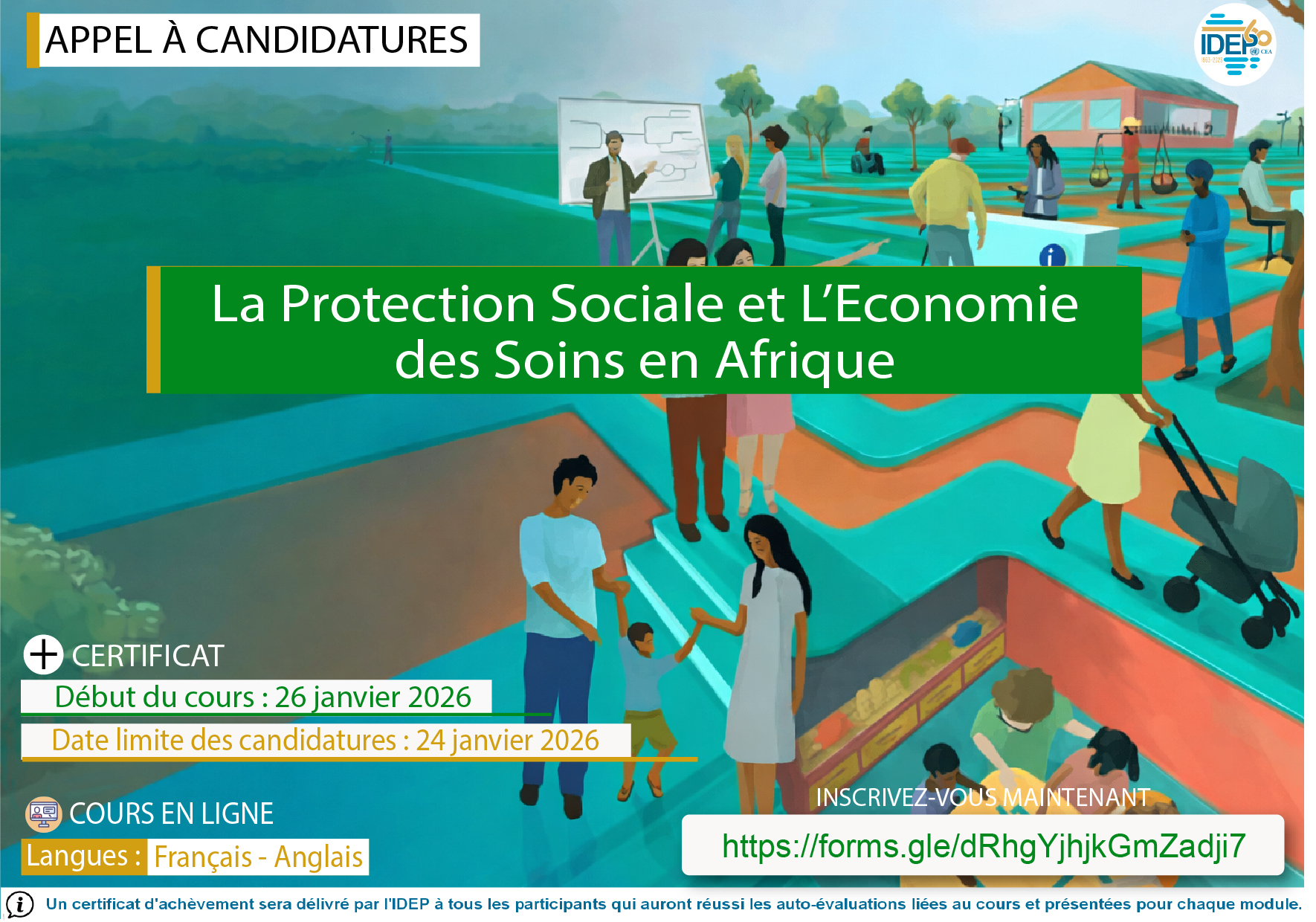
Les sociétés africaines subissent actuellement des transformations majeures qui mettent à l'épreuve leurs systèmes de protection sociale et leurs populations vulnérables.
La première transformation s'opère sur le plan économique. L'Afrique a connu un démarrage fulgurant au XXIe siècle, se hissant au deuxième rang mondial des régions à la croissance la plus rapide entre 2000 et 2015 (UNECA 2015). Toutefois, cette croissance est au ralenti depuis, et sous l'effet persistant de la crise financière mondiale et de la chute des prix des matières
premières. Elle s'est même enrayée ces dernières années ; les crises sanitaires et géopolitiques liées à la pandémie de COVID-19 et à la guerre en Ukraine ayant mis en lumière la grande
vulnérabilité du continent aux facteurs externes. Ces tendances ont entraîné des conséquences désastreuses sur l'emploi et la sécurité économique, compte tenu de la faible diversification de l'économie et de sa dépendance aux industries minières et extractives.
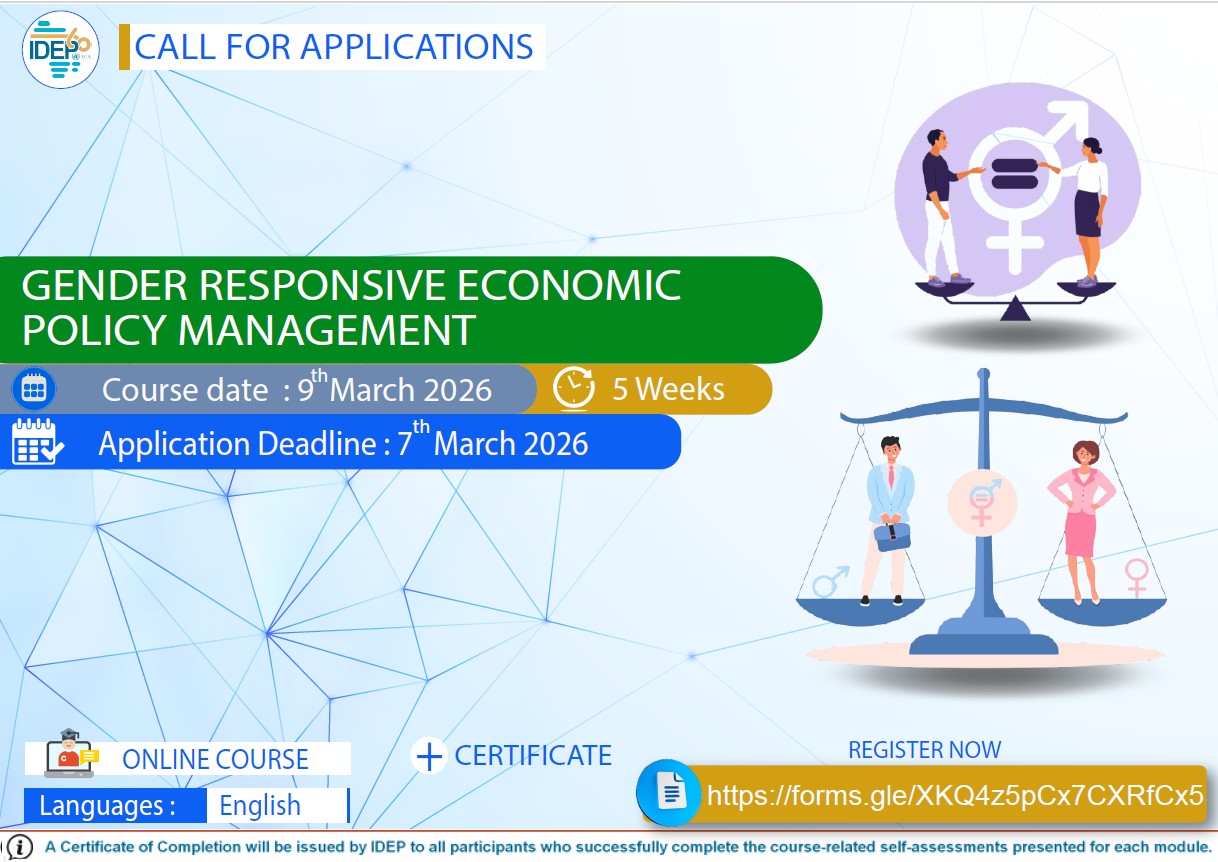
The course on Gender-Responsive Economic Policy Management aims at providing policymakers and development practitioners with the required skills and knowledge that are needed to identify and address gender biases in the economic sectors and to analyze economic policies and budgets from a gender perspective.
The course is also expected to enhance gender awareness in economic policy formulation, financing and implementation, as well as sharpen the understanding of participants on the links between gender and economic policy formulation and management.
From this course, it is expected that participants will become familiar with the analysis and use of gender concepts, tools and strategies; Expected skills upon completion include:
Fostering an enhanced conceptual understanding of gender concepts in economic
policy design, financing, implementation and evaluation.
- Enabling participants to acquire knowledge and expertise to formulate, implement, monitor, and evaluate policies, programs and budgets from a gender perspective.
- Providing participants with knowledge and expertise to mainstream a genderperspective in national development policy dialogue and planning as well as ininternational negotiations.
- Providing participants with the tools and mechanisms to deal with successive socioeconomicshocks in this period of uncertainty and crises as women are particularlyimpacted.
- Developing gender mainstreaming action plans that will enhance gender equality and women empowerment in the formulation, implementation, monitoring, and evaluation of policies, strategies, programs and projects.
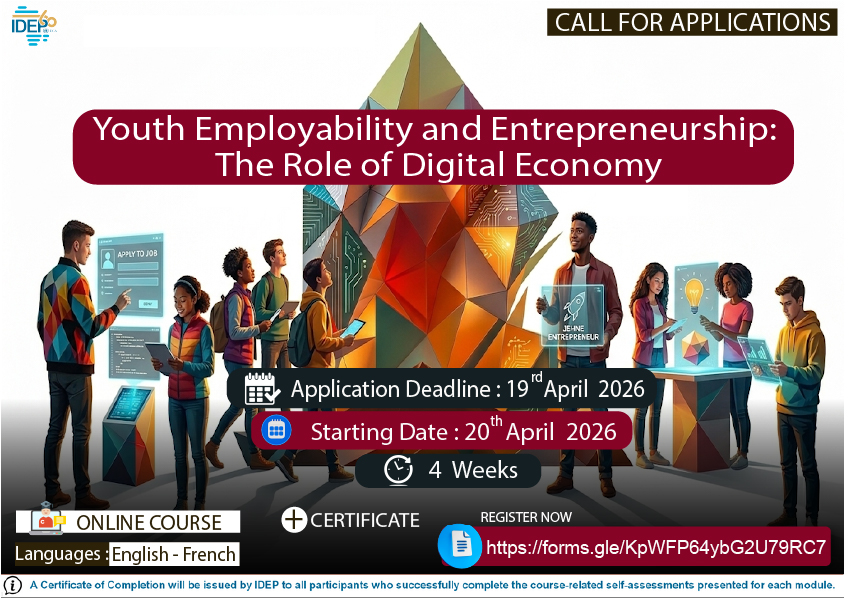
The overarching objective of this course is to provide mid and senior level officials and decision makers with the necessary skills, tools, and mechanisms to harness the potential of the digital economy to alleviate youth unemployment and foster economic growth in Africa.
The specific objectives are to :
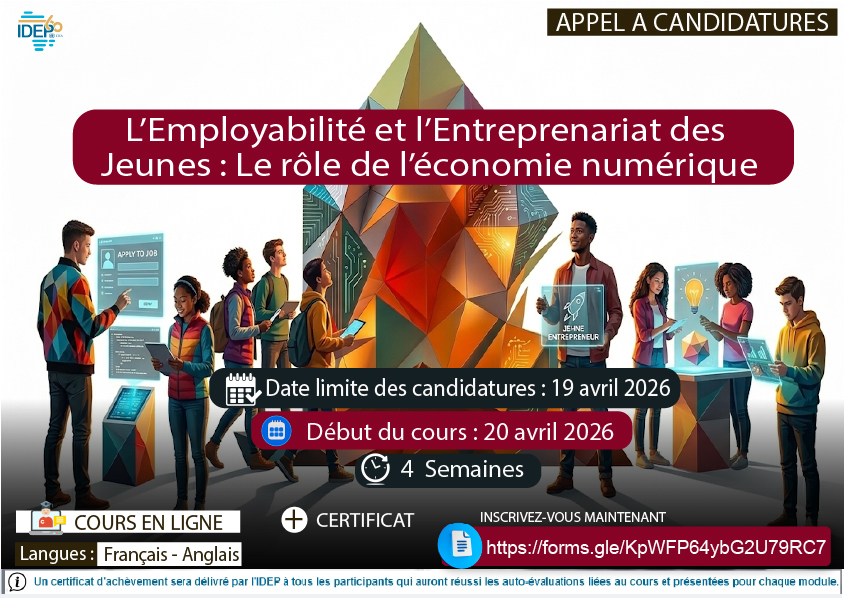
L’objectif principal de ce cours est de fournir aux fonctionnaires et aux décideurs de niveau intermédiaire et supérieur les compétences, les outils et les mécanismes nécessaires pour exploiter le potentiel de l’économie numérique afin de réduire le chômage des jeunes et de favoriser la croissance économique en Afrique.
Les objectifs spécifiques sont:
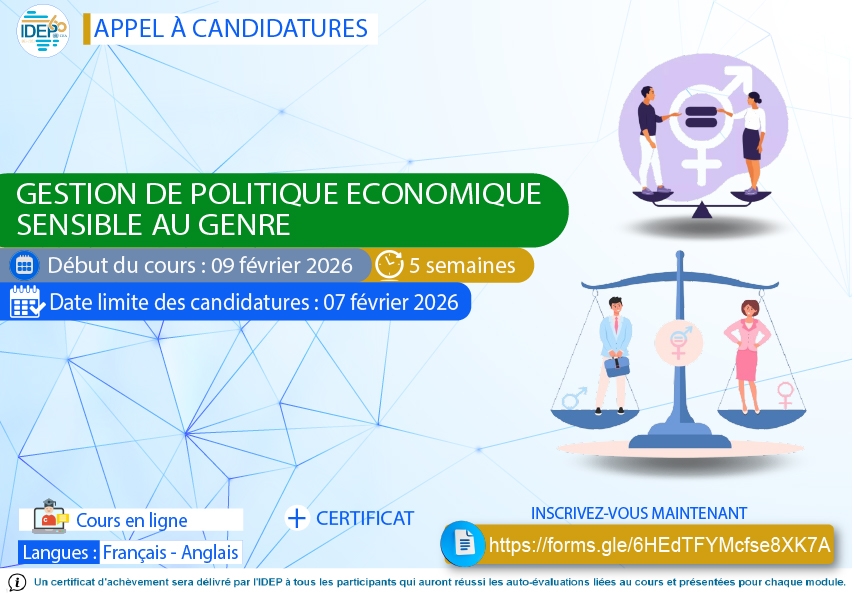
L’égalité des sexes est un droit humain fondamental et un fondement nécessaire à un monde pacifique, prospère et durable. Dans l’Agenda 2030 pour le développement durable et l’Agenda 2063 de l’UA, l’égalité des sexes est reconnue comme un catalyseur essentiel du progrès dans tous les domaines du développement. Les deux cadres qui visent à parvenir à une croissance inclusive et à un développement durable offrent de nouvelles opportunités de changement transformateur pour les femmes et les jeunes en Afrique.
À l’échelle mondiale, la demande d’intégration des perspectives de genre dans le cadre de développement national s’accroît, car on se rend compte que l’égalité et l’équité entre les sexes sont essentielles à la croissance économique et à la réduction de la pauvreté dans les pays développés et en développement.
Le cours sur la gestion des politiques économiques sensible au genre vise à fournir aux décideurs politiques et aux praticiens du développement les compétences et les connaissances nécessaires pour identifier et traiter les préjugés sexistes dans les secteurs économiques et pour analyser les politiques économiques et les budgets dans une perspective de genre.
Le cours vise aussi à renforcer la prise de conscience de l’importance du genre dans la formulation de la politique économique et sa mise en oeuvre, et également approfondit la compréhension qu’ont les participants des rapports entre le genre et la formulation et la gestion de la politique économique. Le cours permettra aussi aux participants de se familiariser avec l’analyse et l’emploi des concepts liés à la problématique genre ainsi qu’avec les outils et les stratégies dans les secteurs économiques. Ce cours est dispensé par l'Institut Africain de Développement Economique et de Planification (IDEP) ; et cette session est uniquement pour les francophones.
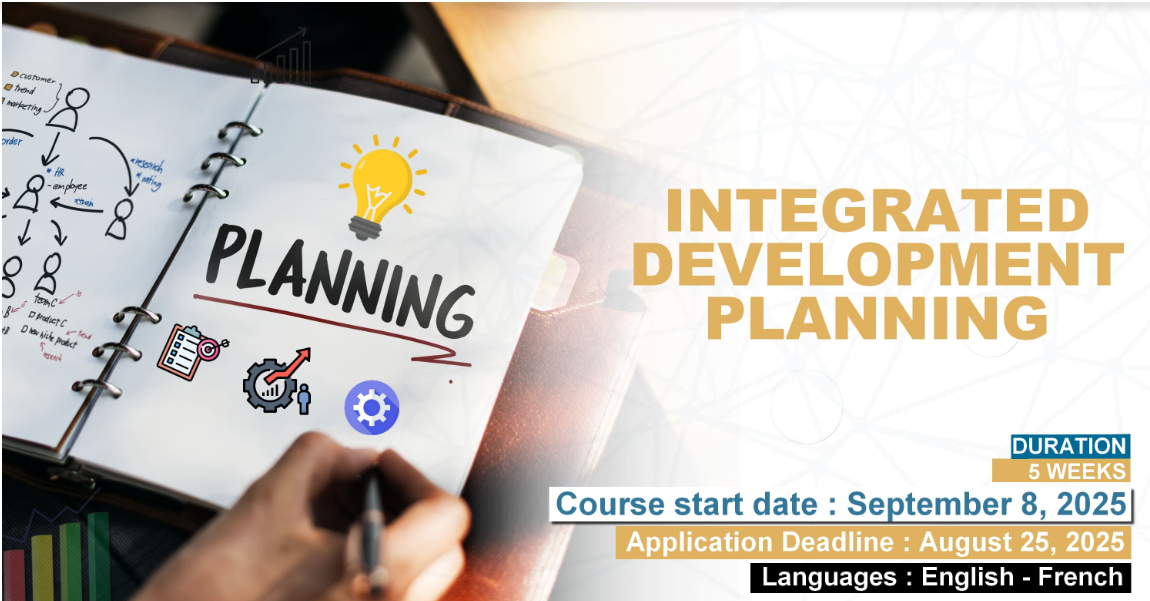
Africa's development is constrained by several interrelated factors that prevent the continent from reaching its full potential. The main challenges relate to limited economic diversification and production capacity, demographic pressures and the resulting social demands, and the effects of climate change. In addition, the continent is vulnerable to the impact of poor governance, recurrent political instability, and geopolitical tensions.
The course aims to strengthen participants' capacities on the integrated approach to development policy planning.
Specifically, the course will enable participants to:
The 2030 Agenda for Sustainable Development, adopted by UN Member States in 2015, includes 17 Goals, 169 targets, and 231 indicators, and is anchored in human rights. The SDGs represent a shift from
the earlier Millennium Development Goals (2000–2015) by being more universal, transformative, inclusive, and comprehensive.
However, the pace of progress is falling short. According to The Sustainable Development Goals Report 2025, fewer than one in five (about 16.7 %) of SDG targets are currently on track globally. In 2025, an estimated 808 million people, roughly 9.9 % of the world population, are living in extreme poverty under the updated threshold of USD 3.00/day (2021 PPP). As far as gender equality is concerned, there is still a lot of work to be done; by 2030 approximately 351 million women and girls will still be living in extreme poverty (UNSD, 2025). Despite gains in education completion rates, 272 million children and youth remain out of school, and learning outcomes are worsening in many places. Conflicts and wars inflict a devastating toll on SDGs as the number of forcibly displaced and stateless people could reach 139.3 million across 136 countries and territories by end-2025 (UNHCR projections).
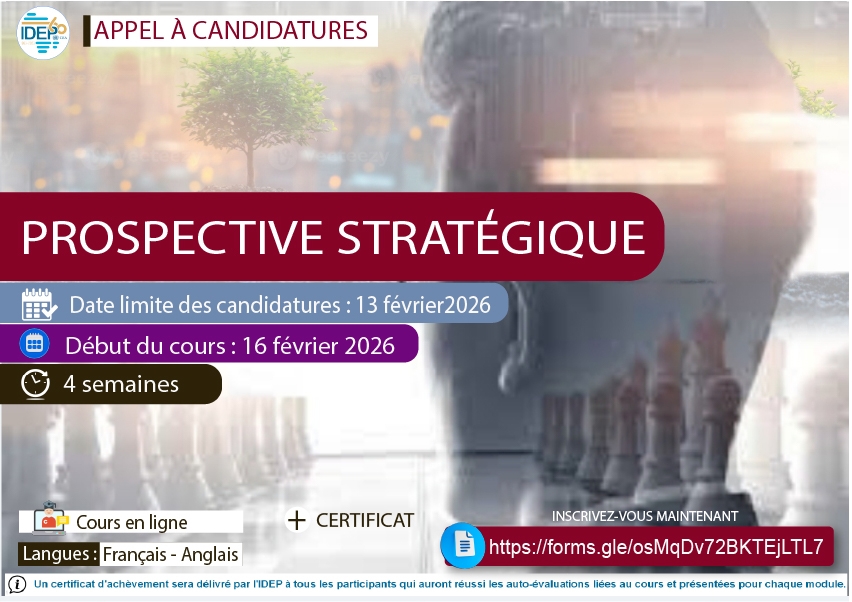
Le cours permettra aux apprenants de comprendre les implications des mégatendances mondiales pour l'avenir du monde et leurs implications pour l'Afrique. Ils acquerront des connaissances sur le rôle de la prospective stratégique dans la conceptualisation des stratégies de développement à long terme pour le continent. Ils auront également une bonne compréhension des concepts clés et des différentes étapes analytiques de l'approche prospective stratégique.
Le cours couvrira les modules suivants :

The course will capacitate learners on the implication of global megatrends for the future of the world and its implication for Africa. They will receive insights into the role of strategic foresight in conceptualizing long-term development strategies for the continent. They will also have a good understanding of key concepts and various analytical stages of the strategic foresight approach.
The course will cover the following modules:
Module 2: History, development and practices of foresight
Module 3: The fundamentals of foresight
Module 4: Foresight approaches and tools
Module 5: From anticipation to action
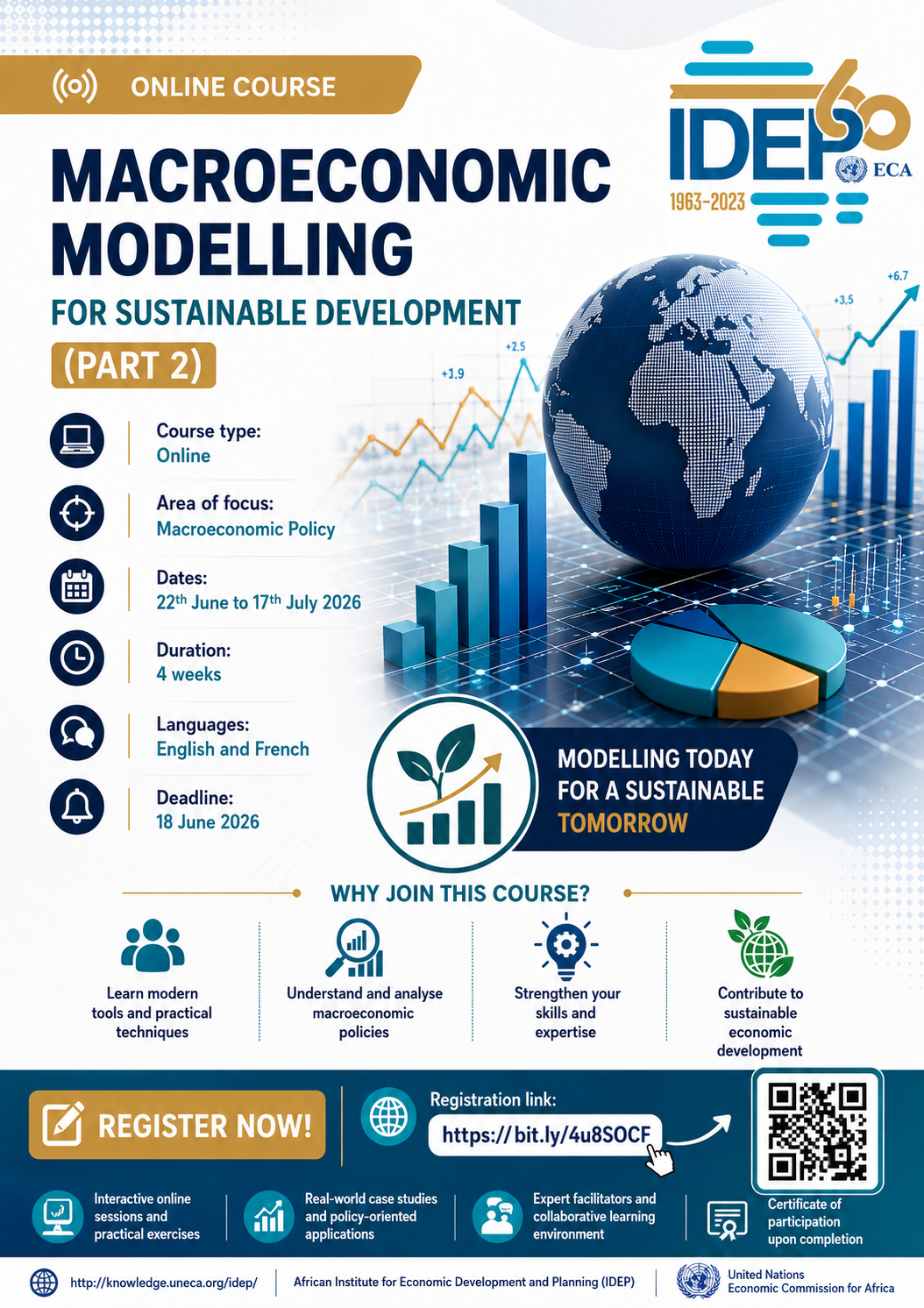
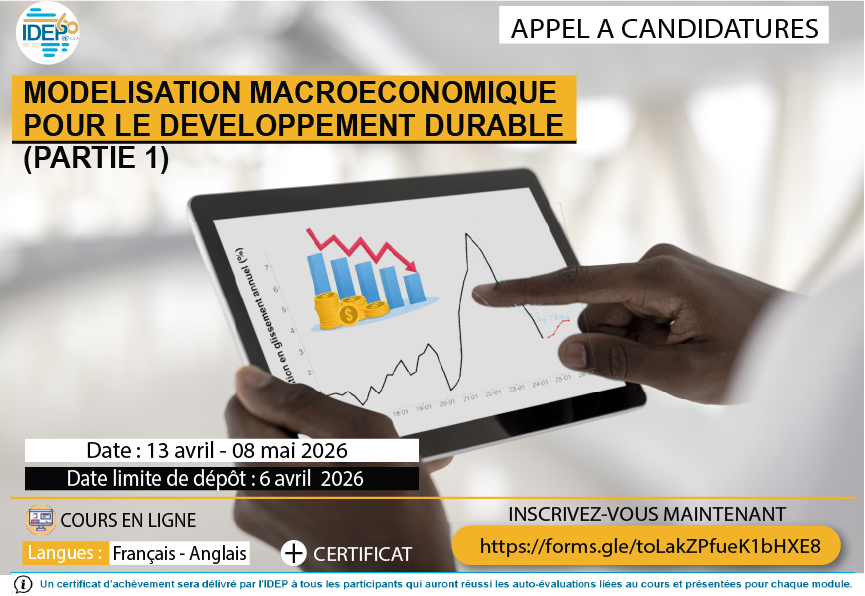
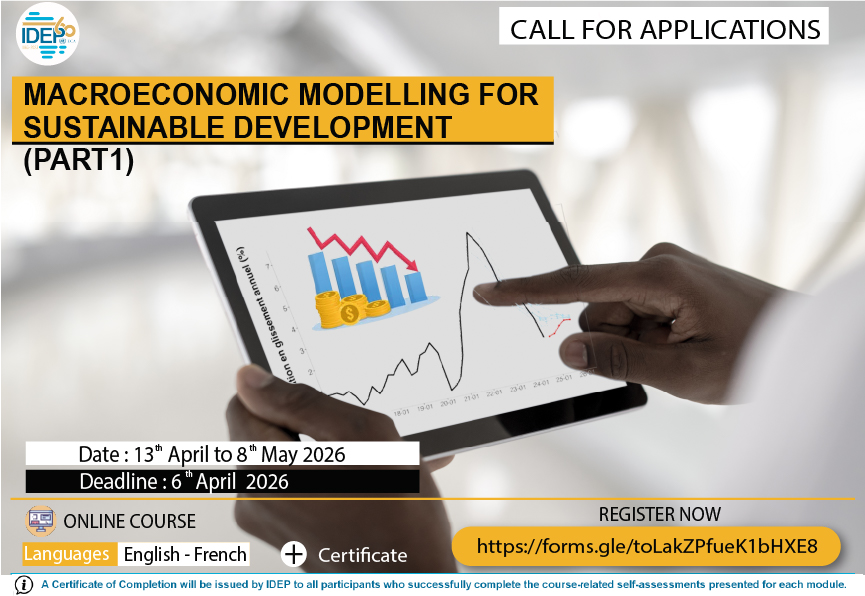
Macroeconomic policy management is an important element in achieving the Sustainable Development Goals (SDGs). It is increasingly recognised as an important core strategy in the implementation of the 2030 Agenda for Sustainable Development and Agenda 2063.
Macroeconomic modelling in this respect is a key decision-making tool, as it aims torepresent the links between different macroeconomic variables in order to answer crucial questions about the impact of policy measures or economic shocks on growth, the functioning of economies, macroeconomic outcomes and the economic welfare inherent in these outcomes, and to make forecasts. Evidence-based policy formulation requires critical analysis of the macroeconomic environment. Models provide an important basis for grounding policy in reality. The results of economic model analysis and projections could inform policy formulation processes and help policy makers to propose relevant and coherent policy interventions in favour of sustainable development. In addition, macroeconomic modelling can be useful for simulating shocks to the achievement of the SDGs. Understanding the methods and tools of macroeconomic modelling is therefore essential for African decision-makers and economists for sustainable development.
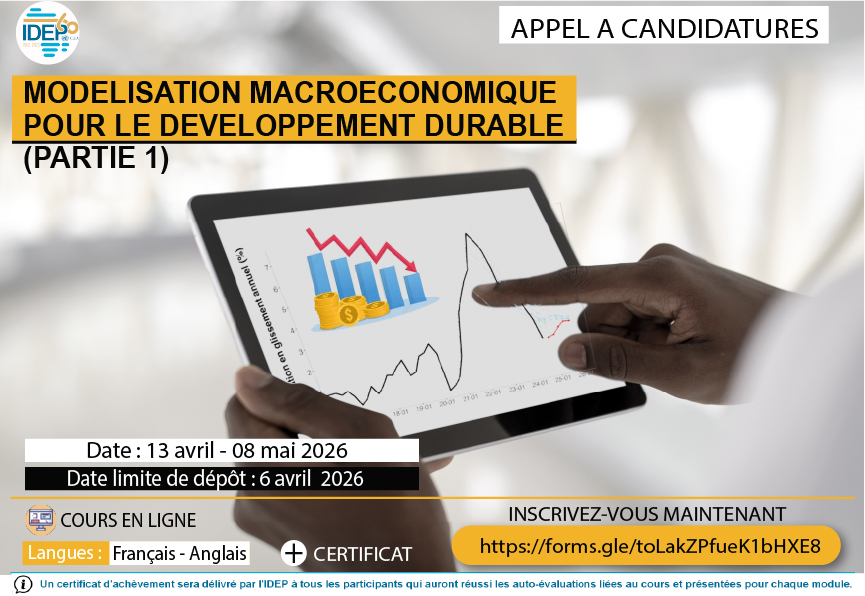
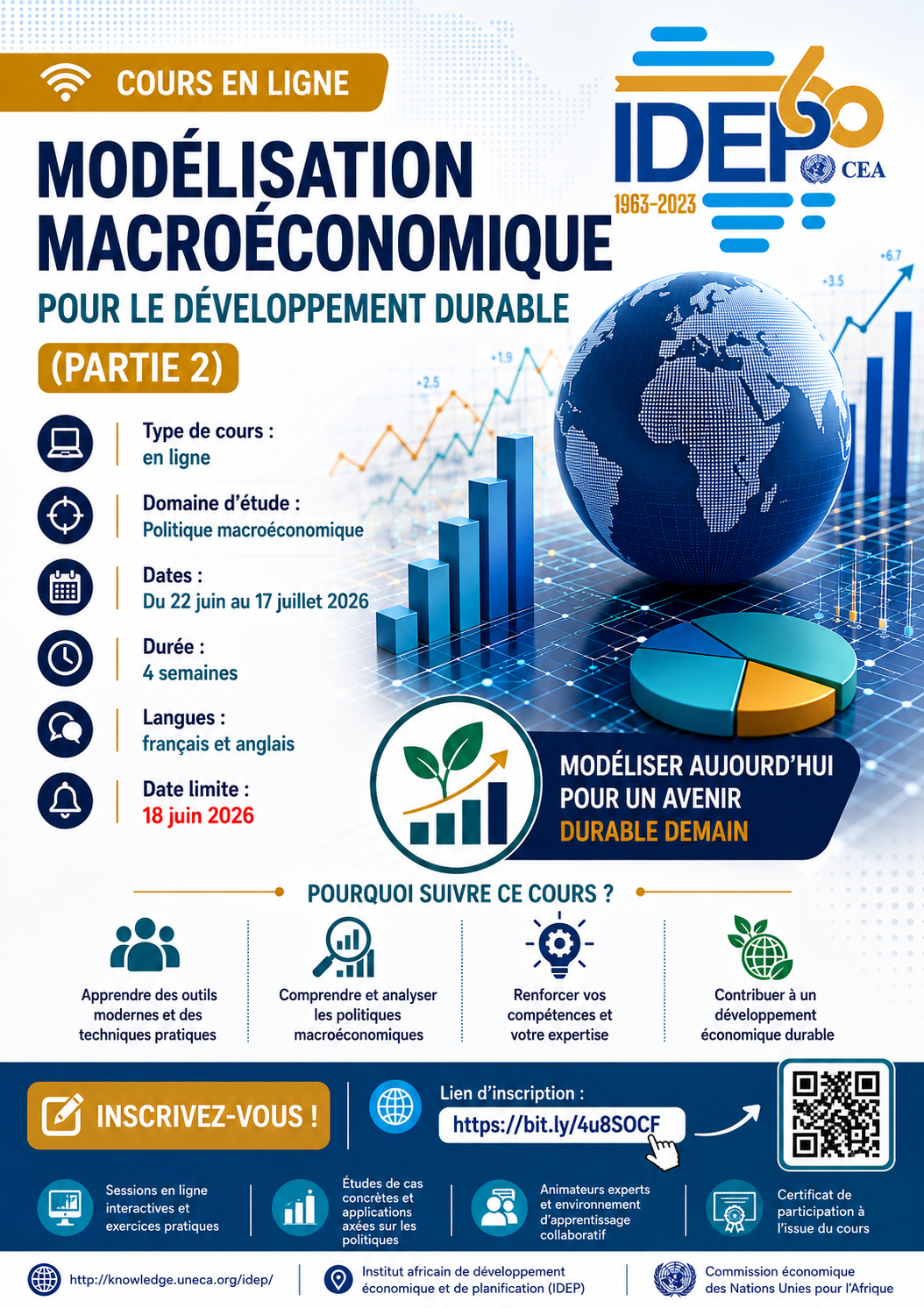
La gestion des politiques macroéconomiques est un élément important pour atteindre les objectifs de développement durable (ODD). Elle est de plus en plus reconnue comme une stratégie fondamentale dans la mise en oeuvre du Programme de développement durable à l'horizon 2030 et de l'Agenda 2063.
À cet égard, la modélisation macroéconomique est un outil décisionnel essentiel, car elle vise à représenter les liens entre différentes variables macroéconomiques afin de répondre à des questions cruciales sur l'impact des mesures politiques ou des chocs économiques sur la croissance, le fonctionnement des économies, les résultats macroéconomiques et le bien-être économique inhérent à ces résultats, et de faire des prévisions. L'élaboration de politiques fondées sur des données probantes nécessite une analyse critique de l'environnement macroéconomique. Les modèles constituent une base importante pour ancrer les politiques dans la réalité. Les résultats de l'analyse et des projections des modèles économiques pourraient éclairer les processus d'élaboration des politiques et aider les décideurs à proposer des interventions politiques pertinentes et cohérentes en faveur du développement durable. En outre, la modélisation macroéconomique peut être utile pour simuler les chocs qui pourraient entraver la réalisation des ODD. Il est donc essentiel que les décideurs et les économistes africains chargés du développement durable comprennent les méthodes et les outils de la modélisation macroéconomiqu
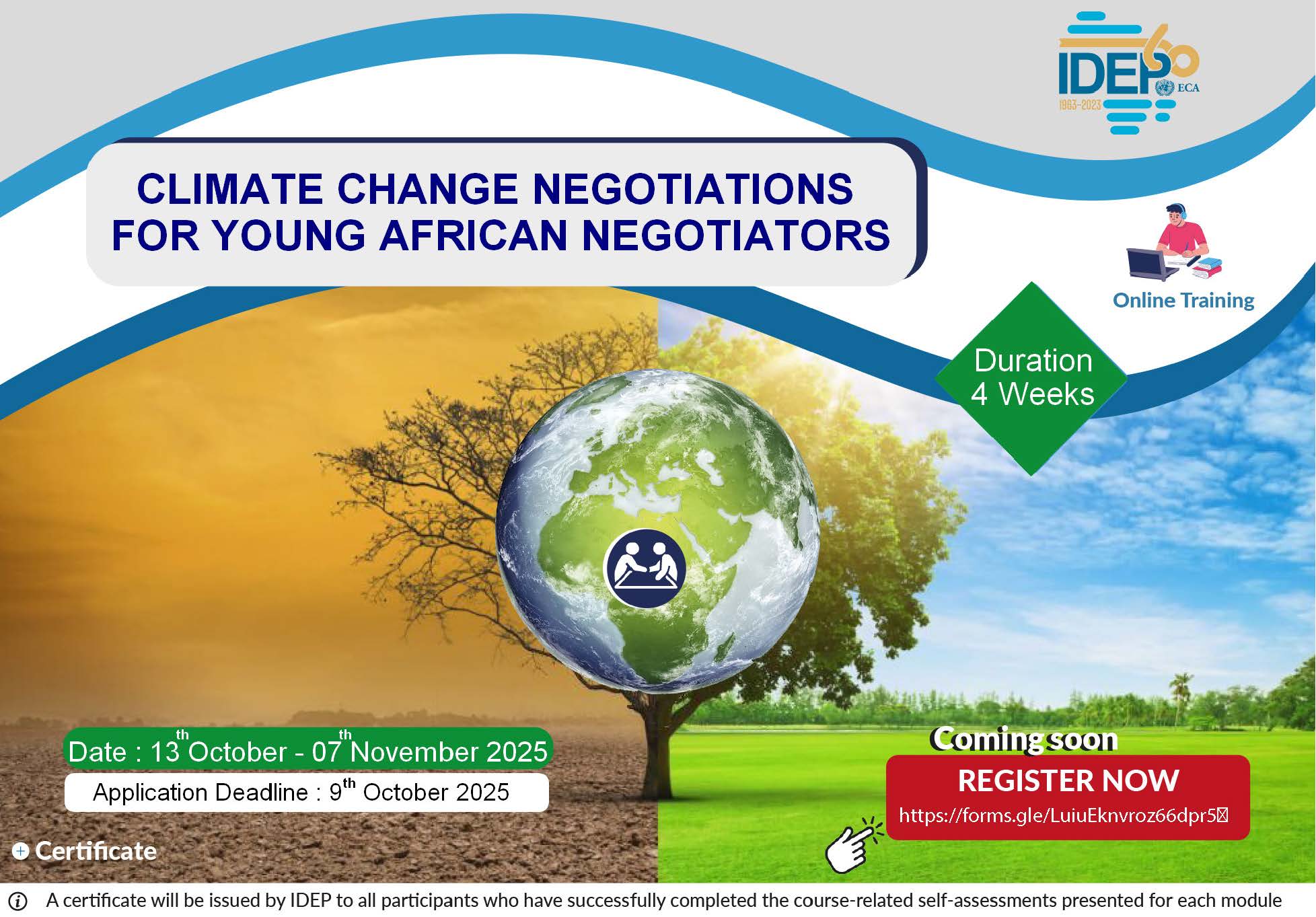
The multilateral climate change processes have evolved over time from the non-binding commitment under UN Convention to the legally binding commitments for developed countries under the Kyoto Protocol and to the Paris Agreement (PA) that build upon the convention and brings all nations into a common cause to undertake ambitious efforts to combat climate change and adapt to its effects, with enhanced support to assist developing countries. The PA also address the issues of loss and damage.
Following the completion of the PA’s rulebook, the process is now focusing on the implementation of mitigation and adaptation with enhanced support to assist developing countries to achieve their commitments. The PA added the loss and damage into its workstream. This online training will deal with negotiation of work programmes under the following areas; just transition; adaptation mainly dealing with adaptation finance and capacity; operationalization of the loss and damage fund and its assessment; negotiating carbon markets; climate finance in the context of financing adaptation, assess to existing funds, methods of tracking, project development, monitoring and evaluation, gender and youth.
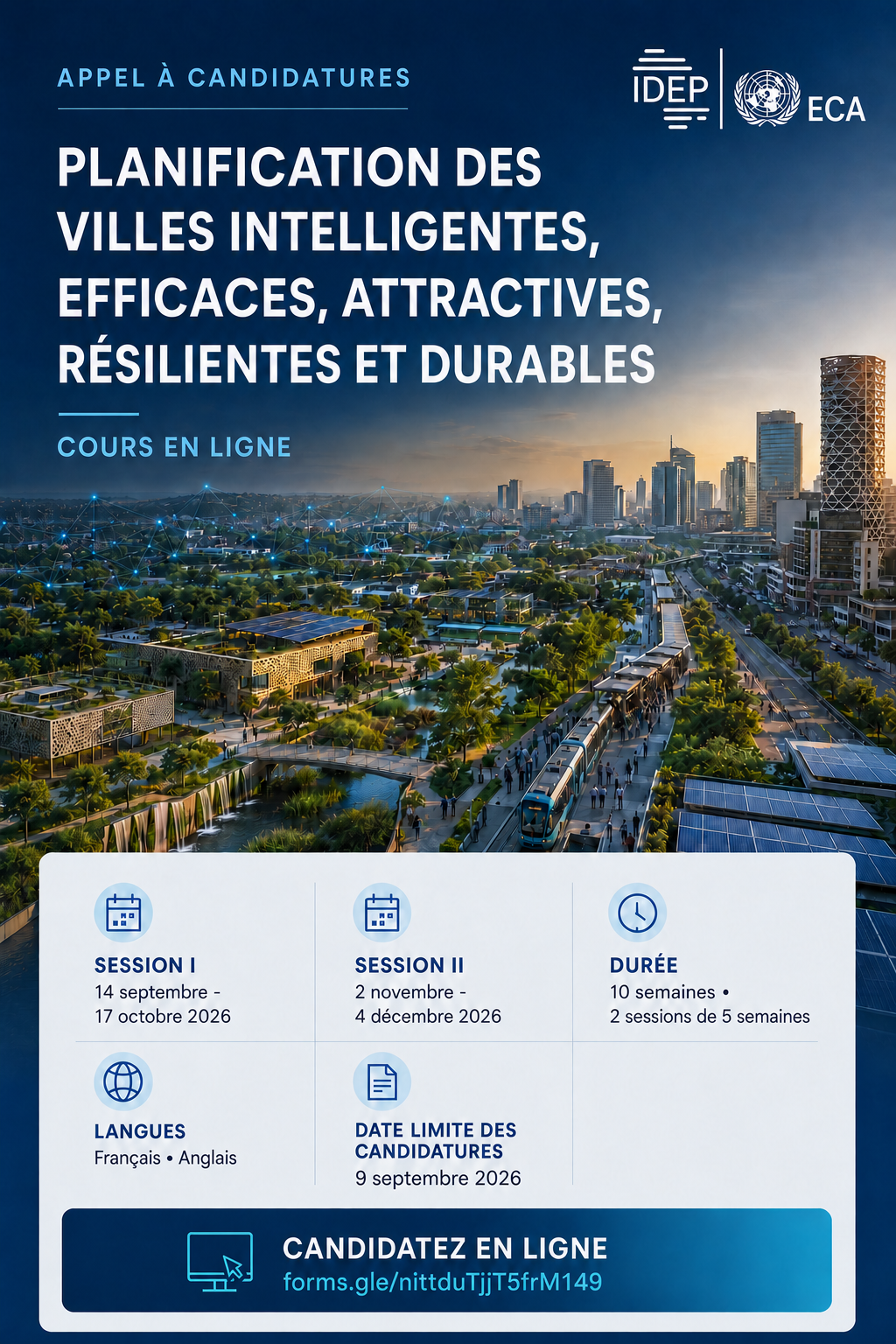
L’Afrique traverse aujourd’hui l’une des transitions urbaines les plus rapides et les plus déterminantes de l’histoire contemporaine. Sous l’effet combiné d’une forte croissance démographique, de l’exode rural, de l’expansion des activités économiques et de l’intensification des échanges, les villes africaines connaissent une transformation profonde qui redéfinit les territoires, les modes de vie et les systèmes de gouvernance. Selon les projections internationales, la population urbaine du continent devrait doubler d’ici 2050 pour atteindre près de 1,4 milliard d’habitants, faisant de l’Afrique l’un des principaux foyers de croissance urbaine dans le monde.
Cette mutation représente à la fois une opportunité exceptionnelle et un défi majeur. Les villes deviennent progressivement les principaux moteurs de croissance économique, d’innovation, de création d’emplois et de développement social. Cependant, cette urbanisation rapide s’accompagne également d’importantes pressions sur les infrastructures, les réseaux de transport, l’énergie, l’eau, l’assainissement, le logement et les services publics. Dans de nombreuses agglomérations, la croissance urbaine dépasse les capacités de planification et d’investissement des pouvoirs publics, entraînant l’expansion de l’habitat informel, la congestion des réseaux, la dégradation de l’environnement urbain et l’accentuation des inégalités territoriales.
Parallèlement, les villes africaines évoluent dans un contexte marqué par les effets croissants du changement climatique, les risques d’inondation, les tensions sur les ressources naturelles et la nécessité de renforcer leur résilience face aux crises sanitaires, environnementales et économiques. La question urbaine ne peut donc plus être abordée uniquement sous l’angle de l’aménagement physique ; elle implique désormais une réflexion globale sur la gouvernance, la durabilité, l’innovation et la qualité de vie.
Les technologies numériques, les données urbaines et les systèmes d’information territoriale offrent aujourd’hui de nouvelles possibilités pour améliorer la gestion des villes. Toutefois, la ville intelligente repose avant tout sur une vision intégrée conciliant efficacité, attractivité, résilience, inclusion et durabilité.
Le présent cours vise ainsi à fournir aux décideurs publics, aux collectivités territoriales, aux urbanistes, aux professionnels du développement et aux acteurs de la gouvernance urbaine les connaissances, outils et méthodes nécessaires pour comprendre les dynamiques urbaines contemporaines et concevoir des stratégies adaptées aux réalités africaines. Il propose une approche intégrée articulée autour de huit dimensions complémentaires : l’urbanisation, les fondements conceptuels des villes intelligentes, la gouvernance urbaine, les données territoriales, la transformation numérique, l’attractivité et l’efficacité urbaine, la résilience et la transition écologique, ainsi que l’élaboration de stratégies de villes intelligentes.
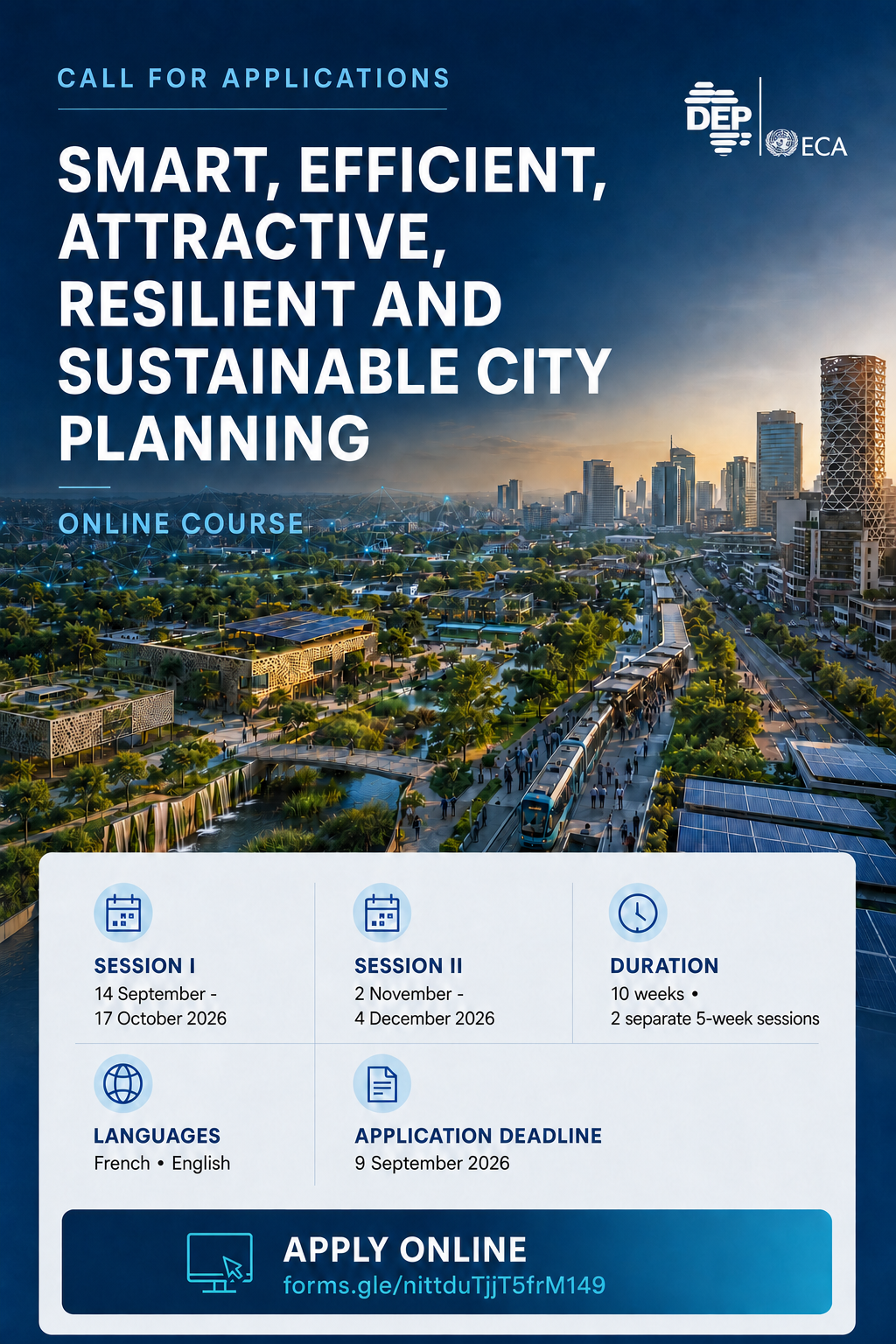
Africa is currently experiencing one of the fastest and most transformative urban transitions in contemporary history. Driven by rapid population growth, rural-to-urban migration, expanding economic activities, and increasing regional and global exchanges, African cities are undergoing profound transformations that are reshaping territories, lifestyles, and systems of governance. According to international projections, the continent's urban population is expected to double by 2050, reaching nearly 1.4 billion inhabitants and making Africa one of the world's leading centres of urban growth.
This transformation represents both an unprecedented opportunity and a major challenge. Cities are increasingly becoming the primary engines of economic growth, innovation, job creation, and social development. At the same time, however, rapid urbanization is placing enormous pressure on infrastructure, transportation systems, energy supply, water resources, sanitation services, housing, and public service delivery. In many urban areas, the pace of growth has exceeded the planning and investment capacities of public institutions, resulting in the expansion of informal settlements, increasing traffic congestion, environmental degradation, and widening territorial inequalities.
At the same time, African cities are evolving within a context characterized by the growing impacts of climate change, increasing flood risks, mounting pressure on natural resources, and the urgent need to strengthen resilience against environmental, health, and economic crises. Consequently, urban development can no longer be addressed solely from the perspective of physical planning; it now requires a comprehensive approach encompassing governance, sustainability, innovation, resilience, and quality of life.
Advances in digital technologies, urban data, and territorial information systems now provide unprecedented opportunities to improve urban management and public service delivery. Nevertheless, a smart city should not be viewed merely as a technology-driven city. Rather, it is founded upon an integrated vision that balances efficiency, attractiveness, resilience, inclusiveness, and sustainability.
This course is designed to equip public decision-makers, local governments, urban planners, development practitioners, and urban governance professionals with the knowledge, analytical tools, and practical methodologies required to understand contemporary urban dynamics and design development strategies that respond to African realities. It adopts an integrated framework structured around eight complementary dimensions: urbanization dynamics; the conceptual foundations of smart cities; urban governance; territorial data and information systems; digital transformation; urban attractiveness and efficiency; resilience and ecological transition; and the design of smart city strategies.